The impact of wine decanter on white wine: what you need to know

Many people equate wine decanters with red wine. After all, red wine and decanting are practically a “constant companion.” But that’s not necessarily the case—white wines can benefit from decanting in certain situations, too. So when is it appropriate to use it? What changes does it bring? Are there any risks? In this article, we’ll discuss the effects of a wine decanter on white wines and how you can experiment with it at home.
Why do people rarely use a decanter for white wine?
The reason for decanting red wine is clear: strong tannins and dark pigments need to be “breathed.” But the situation is different for white wine:
- Most baijiu is lighter, and the aroma is very open as soon as the bottle is opened, without so much “structure that needs to be loosened.”
- Liquor is generally more afraid of oxidation, and excessive exposure to air will make it lose its freshness.
- Many liquors are designed to be drunk right out of the bottle and do not require any special processing.
- Therefore, most people will not deliberately pour white wine into a wine decanter.
- However, don’t be too dismissive. In some cases, baijiu can surprisingly taste better when placed in a decanter.
Which liquors are suitable for decanting?
Here are a few common situations:
1. Young, tightly closed baijiu
: When first opened, some Chardonnays or oak-aged baijiu can appear stiff, their aromas restrained. Pour the wine into a decanter and allow it to air slightly, allowing the fruity and floral aromas to emerge. Wine Enthusiast notes that these “tightly closed” baijiu improve significantly after decanting.
2. A reduced or slightly off-flavored aroma.
Some baijiu may initially smell like lighter fluid or sulfur. This is a typical “reduced” aroma issue. A brief decanter for a few minutes can dispel these aromas.
3.
If the wine is too cold in the refrigerator, the aroma is completely suppressed. Pour it into a room-temperature wine decanter to warm it up faster, allowing the fruity aroma to return more quickly. Some people use this trick specifically to treat over-chilled Chardonnay.
4. Special styles of baijiu,
such as orange wine, skin-contact baijiu, or some complex oak-aged baijiu, are rich and can naturally withstand more oxygen. Using a decanter will actually make them even more charming.
The changes that aeration brings to white wine
Using a wine decanter to treat liquor may produce several noticeable changes:
- The aroma is more open: fruit, floral, and even honey and mineral notes are more easily detected.
- A softer palate: the acidity may become less sharp, and the overall wine smoother.
- More suitable temperature: Especially the wine just taken out of the refrigerator can be restored to the best drinking state in a few minutes.
- But be careful about over-oxidation: Baijiu is sensitive to air, and leaving it decanted for too long can actually rob it of its soul. WineAndMore advises against decanting fresh, fruity, or sparkling wines for extended periods.
How to use a wine decanter to decant white wine correctly?
In fact, it is not complicated, but details determine the experience:
- Choose the right decanter: For white wine, it is recommended to use a small decanter with a narrow neck, rather than one with an extra-wide base like that for red wine.
- How to pour wine: Tilt gently to let the wine flow down the inner wall; do not pour it hard.
- Control time: 5-15 minutes is enough for most liquors, and the tightly closed type can be extended to 20 minutes.
- Observe at all times: smell it, taste it, and if the aroma is just right, drink it immediately.
- For the unfinished portion, it is best to pour it back into the bottle and store it sealed.
Tip: Be very cautious with aged liquors, as they often only require a “light shake in the glass” rather than a full decant.
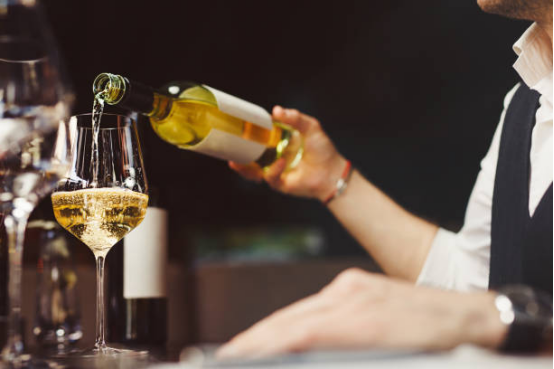
Which baijiu is worth trying? Which should you avoid?
White wine suitable for wine decanter
- Oak barrel-aged Chardonnay
- A mineral-rich white wine from a cool climate
- Orange Wine/Skin Contact White
- Liquor that is not cold-stabilized and may contain tartar salt crystals
Unsuitable liquor
- Fruity, fresh-drinking Sauvignon Blanc
- Extremely old, fragile aged liquor
- Sparkling wine, champagne (decanting will directly “deflate.”)
- Already oxidized liquor
Is the difference before and after sobering up really that big?
The answer varies depending on the wine. Some say the difference is noticeable, doubling the aromatic depth; others argue that some baijiu wines don’t need to be decanted or even become more bland after decanting.
I’ve personally tried several oaked Chardonnays—they were quite creamy upon opening, but after decanting, the fruit and acidity became much more balanced. However, I once decanted a Riesling for 20 minutes, and it completely lost its fresh apple aroma.
Therefore, decanting is not an absolute plus but more like a small spice. You have to judge by tasting.
Common Misconceptions
- I thought decanting could save all wines—no, quality issues cannot be solved by decanting.
- Waking up for too long—liquor is really afraid of excessive oxygen; 15 minutes is a safer range.
- Using the wrong decanter—A decanter that is too large or too wide will accelerate oxidation, which the liquor cannot withstand.
Conclusion: Should I wake up? It depends.
If the aroma of a white wine is closed, reductive, or complex, use a wine decanter to gently revive it. You might be pleasantly surprised.
If it’s fresh and ready to drink, with a beautiful aroma, there’s really no need to bother.
So, the answer is not all baijiu should be decanted, but some truly deserve five to ten minutes to breathe.
Next time you open a bottle, try a small wine decanter and experience the transformation that happens in that split second.