How to change the acidity and astringency of wine using Wine Decanter

When a bottle of wine is poured into a wine decanter, it’s not just an elegant gesture but an art of transforming the wine’s character. Many wine enthusiasts know the importance of decanting, but few truly understand how wine decanters affect acidity and astringency. This article will take you deep into the science and sensory logic of decanting and teach you how to make your wine taste more balanced and smooth.
Table of Contents
I. The True Function of Wine Decanter
Before we begin, let’s clarify one question: what exactly does a wine decanter do?
In short, the two main purposes of a wine decanter are:
- Separating sediment—especially in older red wines, fine sediment tends to form at the bottom of the bottle. Using a decanter can make the wine clearer.
- Promoting oxidation—this step is crucial. Through contact with air, the aromas in the wine are released, the structure of the tannins gradually softens, and the sharpness of the acidity may also be “weakened.”
Many people are surprised by the changes in the wine when they use a wine decanter for the first time: the previously closed aromas are opened up, the astringency is reduced, and the taste is more rounded.
However, it’s important to note that decanting doesn’t actually “chemically change” the acidity or tannin content. It changes your perception.
II. Acidity and Astringency: Two Forces Affecting the Balance of Wine
Before discussing the effects of sobering up, let’s understand these two key terms: “acidity” and “tannin.”
1. Acidity
- Acidity is one of the most important structures in wine, giving it a refreshing and vibrant taste. High acidity balances sweetness and alcohol, keeping the wine fresh. However, if the acidity is too high, the wine will taste “sharp” or “irritating to the tongue.”
- The sources of acidity include tartaric acid, malic acid, and citric acid, which are formed during grape growth and are almost impossible to completely change through later processing.
2. Astringent sensation
- The astringency comes from tannins. Tannins are mainly found in grape skins, seeds, and stems. Young red wines have a high tannin content, which can give a “tight” and “dry” feeling on the palate.
- When tannins are too strong, the wine tastes rough and unbalanced. However, upon contact with air, tannins react with oxygen, gradually softening their structure and reducing the astringency on the tongue.
III. How Wine Decanter Affects Acidity and Astringency
This is the core of this article: Can using a wine decanter really change the acidity and astringency?
1. Softening of tannins
Most experts agree that decanting does indeed soften the “feel” of tannins.
When wine comes into contact with air, oxidation begins. Aromatic molecules in the wine are released, and tannins polymerize and enlarge, resulting in a smoother texture on the tongue.
In other words, a wine decanter doesn’t “reduce” the amount of tannins but rather changes their structure and how you perceive them.
2. Perceived changes in acidity
The actual acidity level doesn’t change with decanting—that’s a scientific law.
But from a sensory perspective, decanting does soften the acidity. Why?
Because the balance between aroma and body affects taste. When aromas are richer and tannins are smoother, our attention is less drawn to acidity. Thus, the acidity seems to “melt” into the overall flavor profile.
That’s the magic of the wine decanter: it changes the experience without changing the essence.
IV. How to use Wine Decanter correctly
If you want to achieve a better balance between acidity and astringency in your wine, you need to know how to use a wine decanter.
1. Choose the right wine
Not all wines need decanting. The following types are best suited for decanting:
- Young, high-tannin red wines (such as Cabernet Sauvignon, Syrah, Nebbiolo)
- Wines with tight structure and “closed” aromas
- Wine that smells slightly sulfurous when first opened
- Conversely, for light, fruit-oriented wines (such as Beaujolais and New World Pinot Noir), prolonged decanting can actually cause the fruit flavors to disappear.
2. Control the sobering time.
Decanting time is closely related to the structure of the wine:
| Types of alcohol | Recommended sobering time |
| Light-bodied red wine | 20–30 minutes |
| Zhongti Red Wine | 30–60 minutes |
| Heavy red wine | 60–120 minutes |
| Old vintage red wine | 10–20 minutes (just to remove sediment) |
Prolonged decanting is not necessarily better. If left too long, the aroma may be lost, and the acidity may become flat and weak.
3. The shape of the decanter
- Wide-bottomed, short-necked wine decanter: suitable for young wines, increasing the surface area exposed to air.
- Narrow-necked, narrow-mouthed wine decanter: suitable for aged wines, to avoid excessive oxidation.
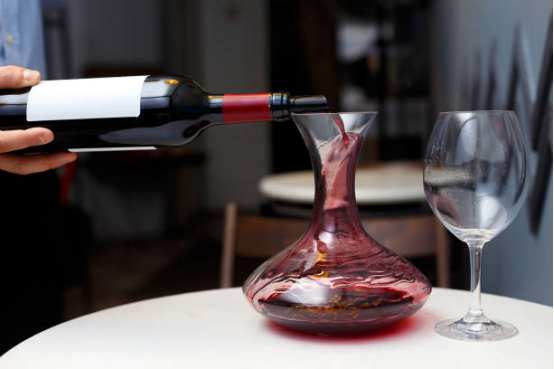
When you slowly pour the wine into the wine decanter, be careful to let the wine flow down the inner wall to avoid too many bubbles or sediment getting mixed in.
V. Sensory Experiment: Changes in Sourness and Astringency
- You can try a simple experiment.
- Open a bottle of young Cabernet Sauvignon.
- The first cup was poured out directly; it didn’t wake up.
- Pour the second glass into the wine decanter and let it sit for 60 minutes.
Comparing the two cups:
- First cup: prominent sourness, tightness on the tongue.
- The second glass: the aroma is more complex, the tannins are softer, and the acidity is no longer “biting.”
Although the acid content is not reduced, you will clearly feel that the second cup is more “balanced” and smoother to drink.
This is the “psychochemical effect” of a wine decanter on acidity and astringency.
VI. Common Misconceptions
There are several common mistakes to avoid when using a wine decanter:
- Decanting reduces acidity
→ False. Decanting does not reduce acidity; it only makes the acidity milder. - All wines should be decanted
→ Wrong. Some light-bodied white wines or aged wines are not suitable for long decanting times, as this will cause them to lose flavor. - Decanting can simulate the effects of aging
→ False. Oxidation is different from aging. Decanting releases aromas in a short period, while aging involves structural restructuring.
VII. Wine Decanter Usage Tips and Summary
Here are some practical tips for making wine smoother using a wine decanter:
- Try a sip before letting it breathe to understand the original flavor.
- To control the air contact area, use a wide bottom for young wines and a narrow neck for older wines.
- Note the temperature: low temperatures will amplify the acidity, so you can slightly warm the wine when decanting it.
- Taste in segments: Take a bite after 20 minutes, 40 minutes, and 60 minutes of resting, and notice the changes.
VIII. Conclusion: Let Wine Decanter be your bridge to wine.
The role of a wine decanter goes far beyond simply making a wine “beautiful.”
It can help wine transition from astringent to balanced, from sharp to rounded. While it doesn’t actually alter the acidity or tannin chemistry, it can enrich your sensory experience.
The next time you pour wine, take a few minutes to let it breathe in the decanter.
You’ll find that the originally cold structure is softened by the air, and the acidity and astringency intertwine to create a pleasant balance.
This is the charm of a wine decanter: to release the truest soul of wine in the simplest way.