How to choose a decanter for Champagne: the perfect balance of bubbles and taste

When it comes to champagne, many people’s first thought is its dense, delicate bubbles. In fact, its charm lies not only in the fizzy, bubbly texture but also in its fruity, mineral, and complex flavors. So, the question is: should champagne be brewed with a wine decanter ?
The answer is: sometimes, but with extreme caution. Champagne, unlike red wine, has bubbles that are particularly sensitive to oxygen and vibration. Proper handling can release aromas and regulate temperature; incorrect techniques can easily “lose” the vital bubbles. Let’s discuss how to choose the right champagne decanter to preserve the bubbles and enhance the aroma.
1. Why should we be especially careful when decanting champagne?
When most people think of wine, they think of red wine. Red wine decanters have large bellies, primarily to soften tannins and allow the aroma to diffuse. But what about champagne? The logic is completely different:
- The carbon dioxide in champagne is particularly “fragile”. If it comes into contact with too much air, the bubbles will disappear quickly.
- Most champagnes are meant to be drunk right out of the bottle.
- If you wake up too early, not only will the aroma disappear, but the delicate foam will also disappear.
So, for champagne, aerating is more like a gentle tap rather than a long breath. It’s a bit like waking a child from a nap—just give them a couple of gentle calls, don’t yell.
2. Several key points for choosing a suitable champagne decanter
So what kind of wine decanter is suitable? You can consider the following aspects:
1. Capacity
A bottle of champagne is usually 750ml, so the decanter doesn’t need to be too large. A small decanter with enough air space is enough. A large decanter will expose too much surface area to oxygen, and the bubbles will disappear quickly.
2. Shape
- The base should be slightly wider, but not as wide-open as a wine decanter.
- It is best to retract the neck a little, otherwise all the bubbles will escape at once.
- The streamline of the inner wall should be smooth so that the wine can flow smoothly when pouring without strong impact.
- Some wine decanters with “duck neck” or curved shapes are quite suitable, which are both beautiful and practical .
3. Material
- Lead-free crystal: beautiful refraction, but be careful not to store wine in it for a long time.
- High borosilicate glass: resistant to cold and heat, more practical.
- Thick glass: feels good, but may be difficult to clean.
- To put it simply: when buying, don’t just look at the appearance, but also consider cleaning and daily use.
4. Pour spout design
This is often overlooked. A good pouring spout allows the wine to flow smoothly down without being splashed with foam. It’s also best to have a strainer or small stopper for easy operation.
5. Ease of cleaning
A wine decanter isn’t just for show; it needs to be cleaned after use. Some designs are so complex that a brush can’t fit inside, which can be awkward. So when choosing one, consider whether it can be cleaned with cleaning beads or a special brush.
3. Champagne decanting skills
Having the right wine decanter isn’t enough; proper use is crucial, too. Even the best equipment won’t save your wine from lost bubbles.
- Get the temperature right: Champagne is best served at 6–8°C. If you’ve just taken it out of the fridge, pouring it into room-temperature decanter will warm it up slightly and enhance the aroma.
- Pour the wine gently: pour slowly along the inner wall, don’t pour it in violently = directly destroy the foam.
- Decanting time is short: 5-10 minutes is generally enough. Vintage champagne can be slightly longer, but never exceed 15 minutes.
- Drink steadily: do not shake when pouring, be gentle.
- Deal with leftover wine: Don’t leave it in the decanter; it’s best to pour it back into the bottle and seal it.
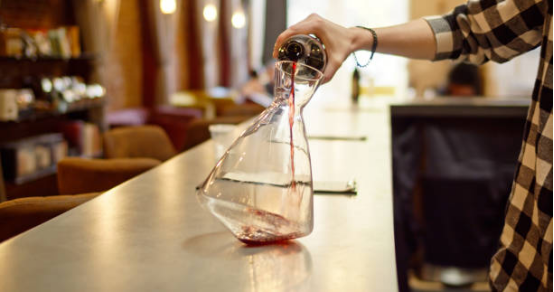
4. Which champagnes are suitable for decanters?
Not all champagnes are worth decanting. They can be roughly divided into the following categories:
Suitable for:
- Vintage Champagne: Complex structure, it will show more layers after decantation.
- Haute Cuvée, Blanc de Blancs, Blanc de Noirs.
- There are oak barrel or full-bodied styles of Champagne.
Unsuitable:
- Entry-level non-vintage champagne is best drunk right out of the box.
- Especially light and delicate styles, bubbles and aroma are easily damaged.
- If the wine is already oxidative, decantation will only make it worse.
5. Common Misconceptions
Some friends may have stepped on these pits:
- I thought decanting the champagne would make it more bubbly (that’s impossible, the bubbles are released by the carbon dioxide in the bottle).
- I think the longer it is allowed to simmer, the better (for champagne, just enough is fine, any longer is a disaster).
- Use a wine decanter to decant champagne (which basically means throwing away the bubbles).
VI. Conclusion
Choosing a decanter for champagne is all about finding the right balance between bubbles and aroma. Remember these three key words: small, gentle, and short.
Next time you open a bottle of champagne, try pouring in a suitable wine decanter and giving it five minutes to breathe. You’ll find that the aroma opens up, the palate becomes rounder, and the bubbles remain vibrant. At that moment, you might think: Hmm, this is the true sophistication of champagne.